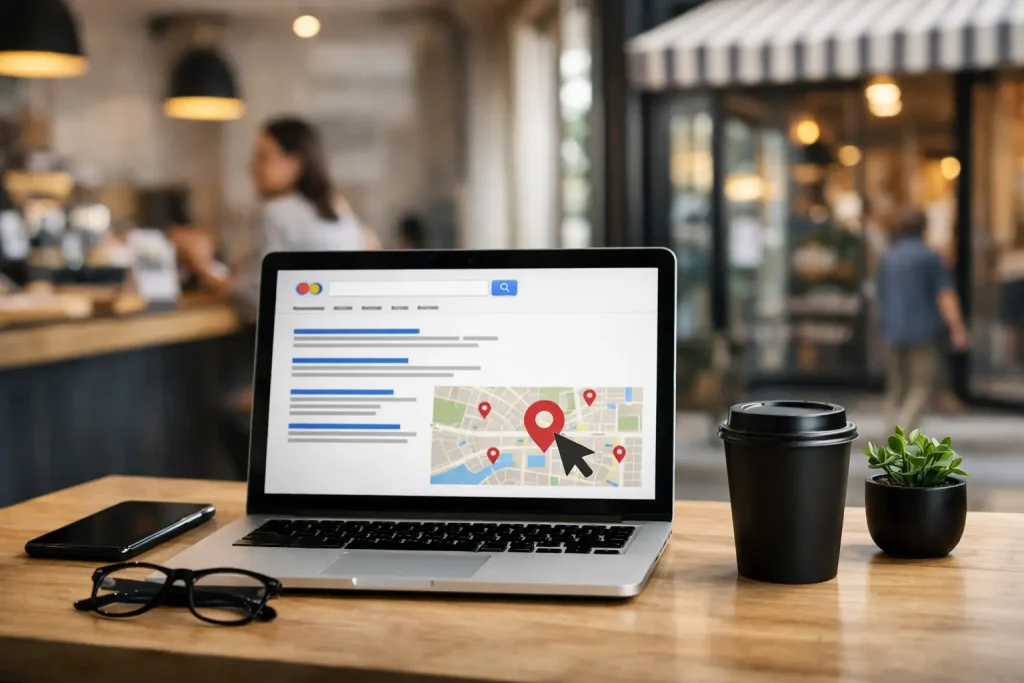
When someone searches for “dentist near me,” “mechanic shop in Puebla,” or “coffee shop open now,” they aren't browsing out of curiosity. They are ready to make a decision. That's where Google advertising for local businesses stops being an interesting option and becomes a direct tool to sell more, with better purchase intent and less wasted budget.
Many local businesses already invest in social media, publish content frequently, and even have a decent website. Still, they struggle to generate quality leads. The problem isn't always visibility. Sometimes it's timing. Google puts you in front of people who are already looking for exactly what you offer, in your area, and at the right time.
Why does Google advertising for local businesses work so well
Unlike other channels where you interrupt the user, on Google you respond to an existing need. That difference changes everything. It's not the same to show an ad to someone who is watching Instagram stories as it is to appear when someone types “labor lawyer in Monterrey” or “English classes for children near me.”.
For a local business, that intent is worth a lot. It reduces friction, improves the likelihood of contact, and speeds up the sale. Furthermore, Google allows for segmentation by location, hours, devices, and search type, which helps in investing more precisely.
Now, the fact that it works doesn't mean it's automatic. There are local campaigns that generate calls from the first week, and others that just consume the budget. The difference is usually in the strategy, not the platform.
It's not just about finishing first
One of the most common mistakes is thinking that advertising on Google is simply “putting money in to appear at the top.” In practice, Google Ads rewards much more than just the bid. The relevance of the ad, the experience on the landing page, and the consistency between what the user searched for and what they find when they click are all important.
If someone searches for “24-hour vet in Querétaro” and your ad directs them to a generic page that talks about all your services, with no clear address, no call button, and no visible hours, you'll lose opportunities even with impressions. Visibility without conversion is expensive.
That's why a well-prepared local campaign doesn't start with the ad. It starts with the offer, the service structure, and the experience the prospect receives after clicking.
What types of local businesses tend to see the best results
Not all businesses leverage Google in the same way, but there are sectors where the impact can be particularly strong. Medical, aesthetic, legal, automotive, educational, real estate, restaurant, clinic, gym, repair, home services, and businesses serving a specific area usually fit well.
The reason is simple. In these times, people look for close, fast, and reliable solutions. If your business depends on customers in a specific city, neighborhood, or radius, Google can become one of the channels with the best return.
Of course, it also depends on the average ticket price, competition, and service urgency. A locksmith or a tow truck compete in a very different context than an architect or a dental clinic. Not everyone needs the same campaign structure, budget, or maturation time.
How to build a local campaign that converts
The basis is understanding what the client is truly looking for and how to turn that search into a concrete action. If your campaign mixes too many services, too many locations, or overly broad messages, it loses its impact. The more specific the intention, the clearer the response should be.
1. Choosing the right searches that actually benefit you
Not every keyword brings customers. Many bring the curious, students, people outside your area, or users looking for free options. A local business needs to focus on searches with commercial and geographic intent.
For example, advertising for “physiotherapy” is not the same as advertising for “sports physiotherapy in Guadalajara.” The latter may have less volume, but a much more valuable intent. This difference impacts the cost per click and also the quality of the leads.
2. Draft ads that respond to a real need
The best local advertisements don't sound generic. They speak clearly, show the location, highlight a specific benefit, and make it easy to take action. If you offer same-day appointments, immediate quotes, home service, or expertise in a particular problem, that should be evident from the ad.
The user doesn't want to guess if you can help. They want quick signs of trustworthiness and relevance.
3. Lead the user to a page designed for conversion
Many campaigns are lost here. A paid click must lead to a place designed to close the next step. That can be a landing page, a well-structured service page, or even a tab optimized for the objective, but not just any destination will do.
The page You should make it clear what you do, where you serve, how to contact you, and why they should choose you. Testimonials, benefits, simple forms, a call button, visible WhatsApp, and reasonable response times make a real difference.
4. Measure true conversions
If you only look at clicks, you don't know if the campaign is working. What matters is how many calls, forms, messages, or appointments were generated and how much each one cost. Without that tracking, it's easy to keep investing in campaigns that “look active” but don't produce sales.
In local businesses, good measurement also helps detect something key: how quickly the business responds and what happens to the lead afterward. Because not everything depends on Google. If sales attention fails, the campaign looks bad even if the traffic is correct.
Common mistakes in Google advertising for local businesses
The first is segmenting too broadly. Wanting to reach the entire city or several municipalities without a clear logic usually lowers traffic quality. Sometimes it's worth starting with the most profitable areas and then expanding.
The second is to use a single campaign for everything. If you mix different services with generic ads, Google understands your offering worse, and so does the user. Separating by service, intent, or location usually improves performance.
The third is not aligning marketing and sales. You can generate leads, but if no one responds quickly, if follow-up is weak, or if there's no sales process, ROI plummets. Marketing attracts. Sales must convert.
It's also common to pause too soon. There are campaigns that require fine-tuning for several weeks to identify useful terms, debug audiences, and improve ads. This doesn't mean tolerating uncontrolled spending, but it does mean understanding that optimization is part of the process.
How much to invest and what to expect
The right question isn't how much Google Ads costs. The question is how much you can invest to acquire a profitable customer. That calculation changes depending on your industry, margin, area, and competition.
A local business with a high ticket price can tolerate higher lead costs if the closing rate compensates for it. Conversely, a low-ticket business needs higher volume, good efficiency, and more agile processes. That's why the budget shouldn't be set on intuition alone or by what “the competition spends.”.
It's also advisable to be realistic with expectations. Google doesn't fix a weak offer, a bad reputation, or slow service. What it does very well is accelerate existing demand and channel it toward businesses that are better prepared to respond.
When is it advisable to rely on a specialized team?
If your business depends on generating constant leads, it's not enough to run ads and wait. It requires strategy, follow-up, and continuous adjustments. A specialized team not only sets up campaigns. They also help refine the offer, improve conversion, and connect lead generation with the sales process.
That's where a full-spectrum agency can make a difference. Not because it performs magic, but because it prevents marketing from operating in isolation from the rest of the business. At Impulzion Marketing, for example, this type of work makes sense when the goal is not simply “to have ads,” but to convert searches into real sales opportunities with a structure that can sustain growth.
Google or social media for a local business?
It's not always a competition between one and the other. They fulfill different functions. Google captures existing intent. Social media helps generate recall, build trust, and maintain presence. If your budget is limited and you need more direct results, Google is usually a most efficient starting point for services with active demand.
If, on the other hand, you sell something very visual, aspirational, or impulse-driven, social media can better complement the strategy. The key is not to treat all channels as if they do the same thing.
The best advertising isn't what gets the most clicks. It's what brings the right customer, at the right time, with a clear proposition and a customer service process that converts. For a local business, that can make the difference between advertising by trial and error or using Google as a real growth tool.