Many businesses invest in advertising, post on social media, improve their website, and even hire a CRM, but they still face the same problem: leads come in on one side, cool off on another, and sales don't grow at the expected rate. That's where understanding how to create a multichannel funnel stops being a marketing task and becomes a business decision.
A multichannel funnel isn't about being everywhere. It's about connecting the right dots so that a person discovers your business, moves forward with confidence, and reaches a conversation or purchase without unnecessary friction. If the channels don't work together, you don't have a funnel. You have scattered efforts.
What is a multichannel funnel and why does it make a difference?
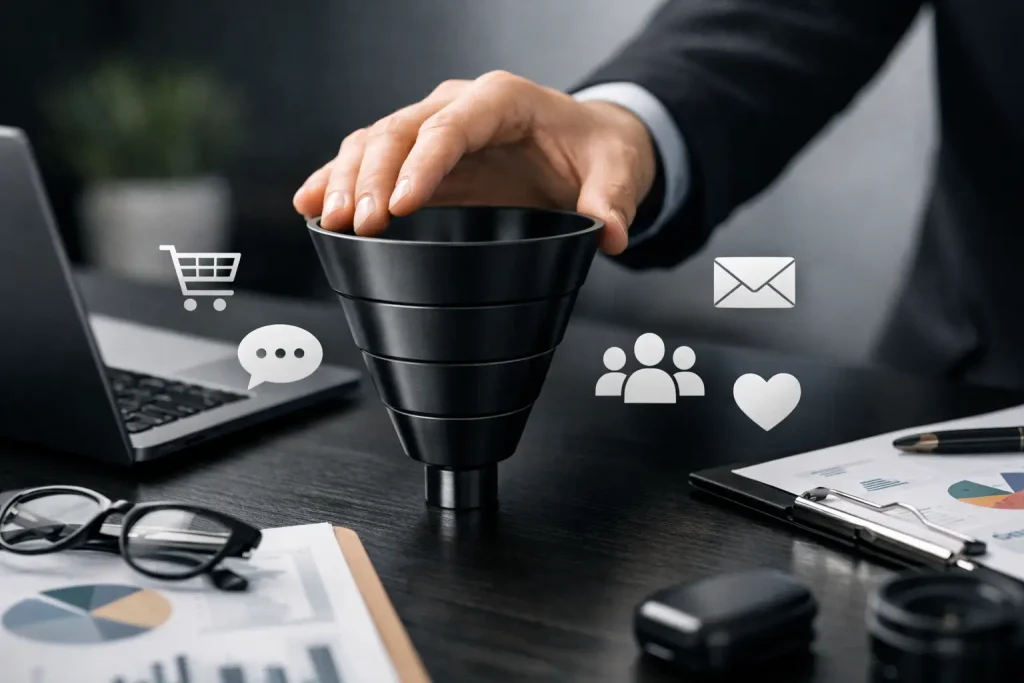
A multichannel funnel is a structure where various channels participate in different stages of the buying process. A prospect might see an ad on Facebook, visit a landing page, provide their information, receive follow-ups via WhatsApp or email, and then close through a call or sales meeting. All of that is part of the same journey.
The difference compared to an isolated strategy is simple: each channel fulfills a function. It's not about asking Instagram to do the work of your sales team, nor expecting a Google campaign to convert on its own if no one follows up quickly. When there's logic behind it, the cost per lead improves, conversion increases, and the business stops depending on a single point of contact.
There's also an important point here: not all businesses need the same funnel. A clinic, a real estate agency, a law firm, or an e-commerce store have different buying cycles. That's why copying someone else's structure usually fails. The foundation should always be your actual sales process.
How to create a multichannel funnel without overcomplicating it
The most common mistake is to start with the tools. The correct order is different: first the business objective, then the customer journey, and finally the channels and automations.
Define the primary conversion
Before choosing platforms, you need clarity on what advancing your business means. For some, it will be a direct purchase. For others, it will be scheduling a call, requesting a quote, filling out a form, or starting a conversation on WhatsApp.
If you try to measure everything at the same time, you'll lose focus. A good funnel has a primary conversion and several microconversions that help move the prospect along. Downloading a resource, watching a demo, or responding to a message are useful signals, but they shouldn't be confused with the central goal.
2. Map the actual decision-making process
It's worth pausing here and being honest. How does your client actually buy? Do they contact you and decide quickly? Do they compare several options? Do they need trust before asking for a proposal? Do they depend on human follow-up?
This step prevents many execution errors. If your service requires explanation, a cold form with too many fields can lower conversion. If your ticket is high, you might need credibility content before pushing for an appointment. If your market responds better via messages than email, your follow-up should adapt to that.
The funnel works best when it respects buyer behavior, not when it tries to force it.
Assign a role to each channel
This is where many businesses get scattered. They want to use social media, Google, email, blog, WhatsApp, SMS, and remarketing at the same time, without defining what each one is for.
A healthier structure would be this: paid campaigns to capture demand, landing page to convert, CRM to organize leads, automation for initial follow-up and a human channel for closing. In some cases, social media and content are used to build trust; in others, Google Ads Capture prospects with higher intent. It depends on the type of service, budget, and the team's response speed.
The key is for each channel to have a clear task. If two channels are doing exactly the same thing, you're likely duplicating effort.
Basic stages of a multichannel funnel
Attraction
In this stage, you need visibility with the right audience. This can be through Meta campaigns, Google campaigns, local SEO, organic content, or referrals. The important thing isn't to be on every platform, but to choose those that best connect with your customer's intent.
For example, if someone is already looking for a specific solution, Google can be more cost-effective. If your market hasn't yet recognized the problem or needs visual inspiration, social media and video might be better for opening the conversation.
Recruitment
Once you attract traffic, you need to convert it into a lead or an opportunity. This is where landing pages, forms, direct messages, calls, or WhatsApp buttons come in. The offer must be clear and the action easy to complete.
A very common mistake is sending everything to the main site. That dilutes the intent. When a campaign has a specific promise, the landing page should continue that same conversation without unnecessary distractions.
Nutrition and monitoring
Not all leads are ready to buy on the first contact. That's why this stage is so important. A welcome email, a short message sequence, well-targeted remarketing, or a call at the right moment can make the difference between a lost lead and a sale.
Here, time matters a lot. If someone raises their hand today and gets a response two days later, the opportunity has already cooled down. A well-built multichannel funnel not only communicates better: it responds faster and with context.
Close
The closing doesn't always happen on the same channel where the relationship began. In fact, for services, it's very common for it to start with an advertisement or form and end with a call, video call, or WhatsApp. That's not a bad thing. Many people buy that way.
What does affect results is the lack of traceability. If you don't know where the lead came from, what they saw before, how long it took them to respond, or at what point they got stuck, it will be difficult to optimize.
What do you need for the funnel to really work
Having active channels isn't enough. You need coordination. And that word, though it sounds simple, is where most businesses get stuck.
First, a clear offer is needed. If the message changes too much between the ad, landing page, and follow-up, the prospect loses trust. Second, you need basic but useful measurement. Not just clicks or reach, but qualified leads, appointments generated, cost per opportunity, and close rate.
Third, you need operations. A funnel can be well-designed and still yield poor results if no one follows up, if the CRM is messy, or if sales and marketing work as separate departments. This often happens in small and medium-sized businesses: there's good intention, but no structure.
That's why many brands prefer to rely on a external team that connects strategy, campaigns, automation, content, and commercial execution. When integrated well, it saves time and gains consistency.
Common errors when creating a multi-channel funnel
The first is wanting to build something too complex from the start. If you don't have a validated offer or consistent follow-up today, adding five new platforms won't solve the problem.
The second is not segmenting. Not all leads deserve the same treatment. A prospect requesting a quote needs a different response than someone who merely downloaded a guide. If everyone enters the same flow, communication quality plummets.
The third is to measure only volume. More leads do not always mean more sales. Sometimes it's best to lower the quantity and improve the intent, especially if your sales team is small.
The fourth is forgetting the human touch. Automation helps tremendously, but it doesn't replace a well-handled conversation when the decision requires trust, budget, or clarifications.
How to know if you're on the right track
A good multichannel funnel isn't always noticeable because it has thousands of leads. It's noticeable because there's continuity. The channels feed into each other, follow-up happens on time, and the team understands what to do with each opportunity.
Some positive signs are clear: the cost per lead stops fluctuating so much, the contact rate improves, prospects arrive with better context, and sales stop depending on luck. Something very valuable also appears: you can detect bottlenecks more accurately.
If you attract traffic but no one converts, the problem might be the page or the offer. If you convert but don't close, perhaps the follow-up or qualification is failing. That visibility is already a real improvement.
How to create a multichannel funnel with a focus on sales
If your business sells services, think of the funnel as a business system, not just a campaign. You need to align messaging, lead generation, response, follow-up, and closing. This involves making practical decisions: which channel brings in demand, which converts best, who responds, in how much time, and with what sales pitch.
At Impulzion Marketing, we see this point again and again: when the funnel is designed from the actual business operations, the results are more sustainable. Not because there's a magic formula, but because each piece makes sense within the sales process.
Start simple, but start with order. A channel to attract, a page to convert, a system to register, a sequence to follow up, and a person responsible for closing can already change the landscape significantly. Then you optimize, scale, or add channels.
The question isn't whether you need more digital presence. The question is whether your current channels are helping you sell or just giving you more work.