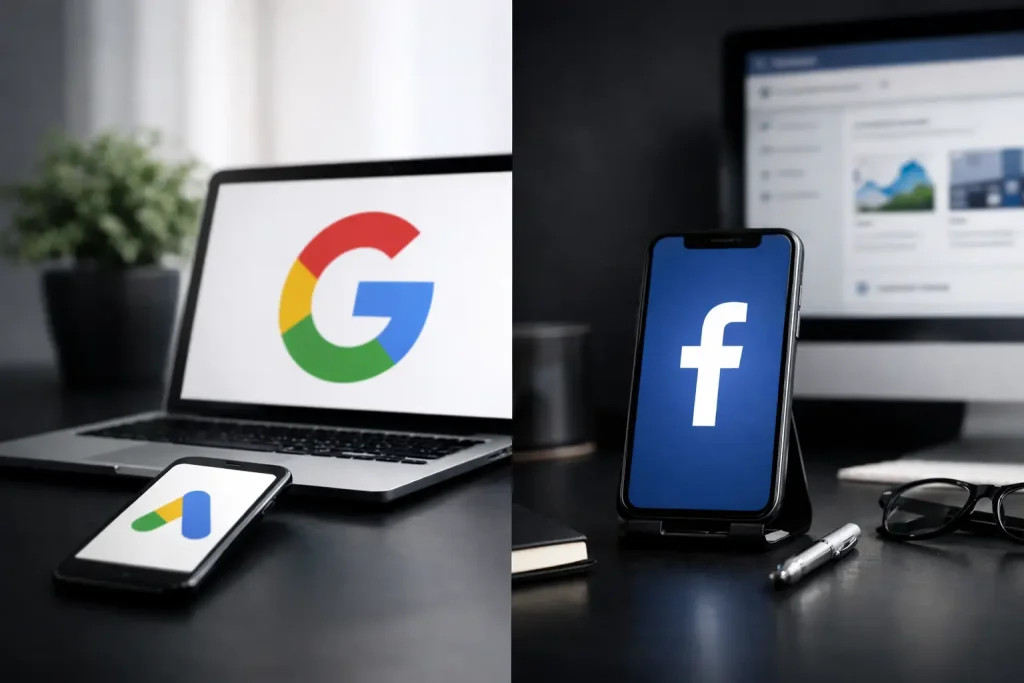
A question almost always arises when a business wants to invest in digital advertising for the first time or fix campaigns that aren't yielding results: Google Ads or Facebook Ads. And the real answer isn't an easy “it depends,” but rather “it depends on what you want to sell, who you want to sell it to, and how ready that customer is to buy.” If that's not well-defined, any platform can seem expensive or inefficient.
The comparison matters because you're not just choosing a channel. You're choosing an acquisition logic. Google Ads works very well when there is a clear search intent. Facebook Ads, which includes Instagram, works better when you need to grab attention, generate interest, and move an audience that isn't actively searching for you yet.
Google Ads vs. Facebook Ads: The Fundamental Difference
Google Ads captures existing demand. Someone searches for something like “dentist in Monterrey,” “immigration lawyer in Houston,” or “industrial uniforms wholesale,” and your ad appears right when there's a concrete need. This makes it a very valuable channel for businesses that rely on high-intent leads.
Facebook Ads do another thing. Instead of waiting for users to search for you, they allow you to put your offer in front of people with certain interests, behaviors, locations, or demographics. This is especially useful when your product needs context, when the purchase doesn't happen out of immediate urgency, or when your brand doesn't yet have enough recognition.
Simply put: Google usually responds better to “I want this now.” Facebook usually responds better to “I'm interested in this, tell me more.” Neither is superior on its own. The key is understanding what stage of the sales process each one fits into.
Google Ads is most beneficial when you want to reach potential customers actively searching for your products or services. It's ideal for: * **Driving immediate sales and leads:** When you have a clear offer and want to attract people ready to buy or inquire. * **Launching new products or services:** To quickly get the word out and generate initial interest and traffic. * **Increasing brand awareness:** For businesses looking to get their name and offerings in front of a wider audience. * **Targeting specific demographics or locations:** To reach a precise audience that is most likely to be interested in what you offer. * **Promoting special offers or events:** To create urgency and drive traffic for limited-time opportunities. * **Competing with rival businesses:** To ensure your products or services are visible when potential customers are searching for solutions your competitors also offer. * **Measuring performance and optimizing:** Google Ads provides detailed analytics, allowing you to track what's working and refine your campaigns for better results. In summary, Google Ads is highly effective when you need to connect with an audience that is already looking for what you provide, or when you need to proactively reach out to a targeted group.
If your business sells something that people already know they need, Google Ads usually has an advantage. Think about medical, legal, maintenance, construction, education, logistics services, or very specific B2B solutions. In those cases, the user typically doesn't want to be entertained. They want to solve a problem.
It's also convenient when you operate locally and need to capture prospects near a specific area. A restaurant can benefit, yes, but an accounting firm, a clinic, or an installation company usually gets more value when they appear in searches with direct intent.
Another strength lies in lead quality. Although the cost per click on Google can be higher in many niches, the probability of conversion can also be better because the user has already taken the first step. You are not interrupting their browsing. You are responding to a need they themselves expressed.
However, Google doesn't forgive a bad structure. If the campaign targets overly broad keywords, if the site loads slowly, or if the landing page It doesn't solve the search intent, the budget goes quickly. In other words, it's not enough to “appear on Google.” You need to show up with the right message and lead the user to a page designed to convert.
Facebook Ads are most beneficial when you want to reach a specific audience, promote a product or service, drive website traffic, generate leads, or increase brand awareness. They are particularly effective for businesses that can visually showcase their offerings.
Facebook Ads is usually a better bet when your offer needs to be seen before it is searched for. This happens a lot in e-commerce, aesthetic services, fitness, restaurants, events, courses, real estate, visual products, or new brands that need to position themselves in the customer's mind first.
Its great advantage lies in segmentation and format. You can sell with an image, a video, an ad sequence, or a one-off offer that connects with a specific pain point. This allows you to build demand, not just capture it.
It also works very well for remarketing. If someone visited your site, opened a form, interacted with your content, or added something to their cart, Facebook and Instagram help you keep your brand top-of-mind and push the next action. In businesses with slightly longer decision cycles, that makes a big difference.
The challenge lies in the intent. At Meta, the user often wasn't looking to buy at that moment. That's why the ad, creative, offer, and follow-up must work better. If there's no clear hook, the campaign generates clicks, messages, or engagement, but not sales.
The most common mistake when comparing platforms
Many businesses compare Google Ads or Facebook Ads as if they were two versions of the same channel. They are not. Measuring them with the same expectations often leads to wrong decisions.
For example, if you sell an urgent service and compare a Google campaign against a Facebook campaign solely based on cost per click, the reading will likely be incomplete. Google might cost you more per click, but it brings you prospects much closer to closing. Conversely, if you're launching a new brand and expect Google to generate volume without enough search volume, Facebook might give you better reach and a better initial acquisition cost.
The right question isn't which platform is cheaper. It's which one gets you to a profitable sale faster.
What to review before deciding
First, observe your customer's purchase intent. If most of your prospects already know what they need and search for it with specific terms, Google should be on your radar from the start. If your customer hasn't clearly identified the solution yet or needs to see examples, testimonials, or visual content to become interested, Facebook might be a better first step.
Afterward, review the value of each sale. When the ticket is high, paying more for a qualified lead can still be an excellent business decision. In those cases, Google usually defends the investment very well. If the product is more impulse-driven, visual, or frequently repurchased, Facebook and Instagram can open up better scaling opportunities.
You also need to look at the sales process. If your team responds quickly, follows up, and works leads well, both platforms can work. But if follow-up is slow or haphazard, many opportunities go cold. Advertising doesn't fix a broken sales process. It just makes that problem more visible.
Google Ads or Facebook Ads depending on your objective
If your priority is to generate high-intent leads in the short term, Google usually comes first. If you're looking for brand awareness, new demand, or nurturing audiences, Facebook often has an advantage. If you want consistent sales, it's rarely about choosing one forever, but rather about putting each channel to work at the right stage.
A professional services firm, for example, can use Google to capture direct searches and Facebook for remarketing and credibility. An online store can use Facebook and Instagram for discovery and Google for branded search campaigns or for products with clear intent. A B2B company can combine search, display, and social to accompany longer cycles.
That's where it changes the game. The best strategy isn't always picking one platform, but rather building a logical sequence between attraction, consideration, and conversion.
Budget: Where every dollar counts the most
With small budgets, the decision needs to be more surgical. If there is existing demand and the service has clear search terms, Google can give you faster results because it puts you in front of users with real intent. If there isn't enough search volume or you need to educate the market, Facebook can help you test messages, audiences, and offers with greater creative flexibility.
But beware of a very common idea: “Facebook is cheaper.” Sometimes it is, in cost per click or per thousand impressions. That doesn't mean it's more profitable. If it generates leads that are less ready to buy, the apparent savings disappear in lost follow-ups, no-shows, or low closing rates.
That's why it's worth looking at business metrics, not just platform metrics. The cost per lead matters, but the cost per sale and the final return matter more.
The best answer for many businesses
If your business already has a clear offer, a functional website, and the capacity to follow up, combining both channels is usually the smartest decision. Google helps you capture existing intent. Facebook and Instagram help you expand your market, reinforce your presence, and re-engage users who haven't converted yet.
However, combining does not mean duplicating ads without a strategy. Each channel needs different messages, targeting, and objectives. When done well, one feeds the other. When done poorly, you just duplicate expenses.
At Impulzion Marketing, we see this all the time: businesses that think their problem is the platform, when in reality the bottleneck is in the offer, the landing page, the sales follow-up, or the lack of a complete structure from ad to closing. The platform matters, but the complete system matters more.
If you're evaluating Google Ads or Facebook Ads today, start with a simple question: do you want to capture existing demand or create new demand and nurture it until sale? That answer will give you much more clarity than any trend, isolated recommendation, or promise of quick results. And when the objective is clear, the investment stops feeling like a gamble and starts working as a strategy.