Many businesses invest in social media, ads, or a website, yet they feel sales aren't growing at the expected pace. The problem is rarely a single channel. What's often missing is structure. A good digital sales funnel example helps understand how to take a person from their first contact to the purchase, without relying on luck or isolated messages.
When the digital business process is well-structured, each action serves a purpose. An advertisement doesn't just generate clicks. A landing page isn't just visually appealing. A CRM doesn't just store contacts. Everything works in a chain to attract, filter, follow up, and close. And that's where a funnel stops being a theoretical concept and becomes a growth tool.
What is a digital sales funnel and why does it change results
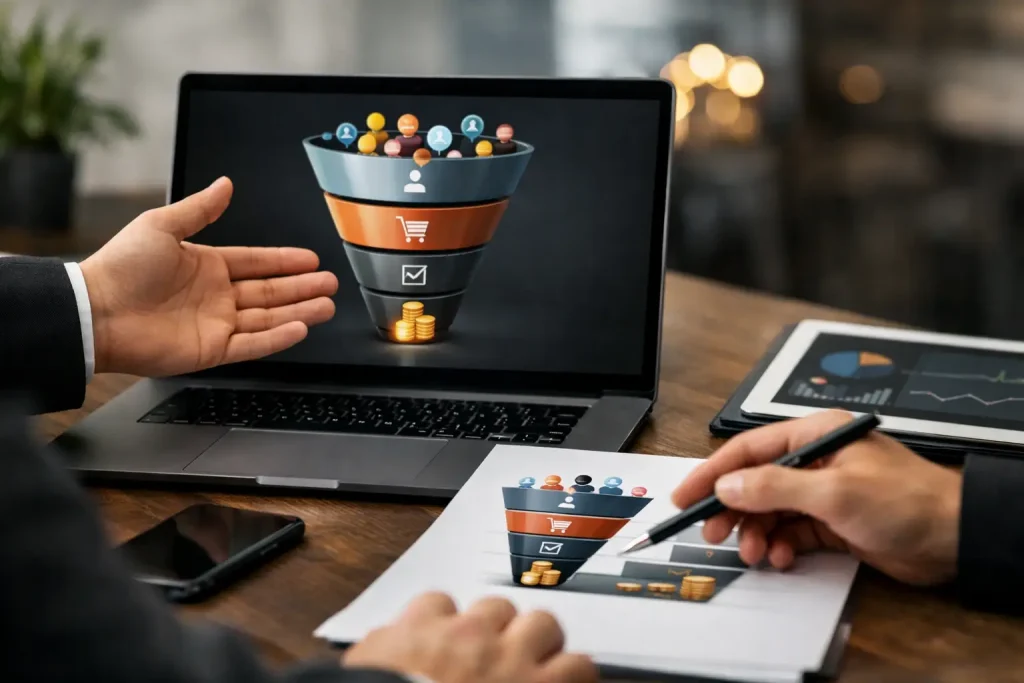
A digital sales funnel is the journey a prospect takes from when they discover your business until they purchase, and even afterward, when they repurchase or recommend your brand. It's called a funnel because not everyone progresses at the same rate. Many people become aware of you, some show interest, and only a portion ultimately convert.
The advantage of thinking of it as a funnel is that it forces you to stop improvising. If you have traffic today but no leads, the problem isn't in closing. If you capture leads but no one responds, perhaps follow-up is weak. If you schedule calls but don't sell, then the friction is in the offer, the prospect's profile, or the way the solution is presented.
Therefore, more than asking if you need a funnel, the real question is how clear is your process for converting attention into revenue.
Digital sales funnel example for a service business
Let's think about a business that offers professional services, like a clinic, an office, a remodeling company, or a marketing agency. Their ticket isn't usually an impulse buy. The customer compares, asks questions, checks for trustworthiness, and needs clear signals before deciding.
In this example, the goal is not to sell immediately from the first ad. The goal is to capture a qualified lead and move them through follow-up to a sales conversation.
Stage 1. Attraction
The funnel starts with traffic. This is where ads on Meta or Google, social media content, local SEO, short videos, or campaigns focused on a specific need come in. The key is that the message doesn't just talk about the business, but about the problem the customer wants to solve.
If a company sells solar panel installation, for example, it's not advisable to just advertise “we are experts.” It's more effective to talk about monthly savings, reduced consumption, or return on investment. Attention is gained when the prospect feels that you understand their context.
In this stage, a common bad practice is to send all traffic to the homepage. That usually divides attention. In lead generation campaigns, it works better A focused landing page in one action.
Stage 2. Lead Capture
Once the person clicks, they arrive at a page designed to convert. There they should find a clear promise, trust signals, a brief explanation of the service, and a simple form. Asking for too much data lowers conversion. Asking for too little can fill your contact base with unhelpful leads. Here, it depends on the type of business and the value of the service.
Following the example, the landing page could offer a free quote, an initial assessment, or brief consultation. It's not always necessary to give away an ebook. For many local or B2B businesses, a well-designed direct contact offer converts better than a downloadable resource.
When the user leaves their data, the lead enters the system. That moment is critical. If there is no automation or quick follow-up, interest cools down in a matter of hours.
Step 3. Nutrition and monitoring
This is where many funnels break. The business has already paid to attract the prospect, it has already managed to get them to leave their details, but then it takes two days to respond or sends generic messages that don't connect.
A helpful follow-up can start with an automated email or WhatsApp confirming receipt, explaining the next step, and opening the conversation. This can then be followed by a short sequence with success stories, answers to common objections, and a direct invitation to schedule.
Not all leads are ready at the same time. Some buy quickly. Others need more context. That's why it's beneficial to have a staged follow-up logic, not a one-size-fits-all approach. A cold prospect needs trust. A hot one needs speed.
Stage 4. Conversion
Conversion happens when the prospect schedules, quotes, or buys. In service businesses, closing often involves a call, a visit, a demonstration, or a business proposal. The digital funnel doesn't replace that step. It prepares them so they arrive better profiled.
The quality of the lead matters a lot here. You can have ten forms a day and sell less than with three if there's no filtering. That's why the funnel must include messages and questions that help separate the curious from potential buyers.
The sales process is also involved. If the proposal takes too long, if follow-up is disorganized, or if no one measures how many leads make it to an appointment and how many appointments convert to sales, the funnel loses steam even if the campaign brings in traffic.
Stage 5. Post-sale and repurchase
A digital funnel doesn't end when payment comes in. If the customer had a good experience, they might buy again, sign up for an additional service, or recommend you. That part is often the most profitable and least worked-on.
A follow-up message, a review request, a remarketing campaign, or a well-timed upsell offer can greatly extend the value of each customer. It's not about pestering for the sake of pestering. It's about maintaining a smart business relationship.
How would this digital sales funnel look in numbers?
Let's assume a monthly campaign with 10,000 people reached. Of those, 500 click on the ad. Of those 500, 60 leave their information on the landing page. Of those 60 leads, 20 respond to follow-up and 8 schedule a call. Finally, 3 purchase.
At first glance, one might say that only 3 people were sold to. But that reading falls short. If each sale represents a profitable ticket, the funnel is working. And furthermore, it already provides concrete information for improvement: perhaps the ad is attracting people, but the landing page could convert more. Or perhaps lead generation is fine, and what's needed is to speed up the sales response.
That's what's valuable about working with funnels. You're no longer just relying on intuition. You can detect where the budget is leaking or where there's a clear opportunity to grow.
What does a funnel need to truly work
It's not necessary to use twenty tools or build a complicated operation from day one. But you do need coordination. A functional funnel typically combines traffic, a clear offer, a conversion-focused page, basic automation, and a tracking system.
It also needs consistency. There are businesses that launch ads one week, then turn them off, then change the entire offer, and finally conclude that digital marketing doesn't work. The problem isn't always the channel. Sometimes it's the lack of process, patience, and measurement.
Another important point is that there is no single ideal funnel for everyone. A business with low-ticket sales can close directly online. One with more consultative services will require multiple interactions before selling. A local business needs speed and immediate contact. A B2B company may require more educational content and a longer cycle. The good funnel is not the most complex, but the one that adapts to how your customer buys.
Common mistakes when copying a digital sales funnel example
The first is copying external structures without checking if they fit your market. What works for infoproducts doesn't always work for local services. The second is only measuring vanity metrics, like reach or clicks, without checking cost per lead, response rate, and closing rate. The third is separating Marketing and Sales as if they were different worlds.
When marketing attracts leads that sales doesn't follow up on, or sales demands results without providing feedback on prospect quality, the funnel breaks. That's why it's advisable to view it as a single commercial system.
There's also a less visible error: wanting to automate too early. Automation helps a lot, but it doesn't fix a weak offer or a confusing message. Strategy comes first, then the tool.
When is it advisable to build with external support
If your business is already investing in digital channels but isn't converting consistently, you probably need more than just posting content or running isolated ads. You need to integrate lead generation, tracking, CRM, Automation and business process with clear logic.
That's where working with a team that understands growth, sales, and execution makes a difference. At Impulzion Marketing, we see it often: businesses that have demand but lose it due to a lack of structure. When marketing connects with follow-up and a well-presented offer, the funnel stops being a pretty idea and starts producing measurable results.
If today you're looking for a digital sales funnel example, use it as a reference, not a rigid recipe. What really drives sales isn't copying steps, but designing a journey that makes sense for your customer, your operations, and your business goal. When that happens, every click starts working with intention.